
The most reliable fix for stubborn patio black spot is a professional-grade biocide treatment left to dwell, then rinsed off at low pressure. Light or early growth often responds to the same approach done yourself.
- DIY route: apply a dedicated black spot remover neat, let it dwell for 2 to 4 hours (longer on stubborn patches), then rinse.
- Hire a pro: Freshexteriors soft washes the area, controls dwell time precisely, and rinses at low pressure to avoid scouring the stone.
- Avoid: household bleach and high-pressure jet washing on sandstone, limestone, or slate. Both can bleach the surface temporarily while leaving the lichen’s roots intact.
Key Takeaways
Persistent patio black spot responds best to a biocide treatment with proper dwell time followed by a low-pressure rinse, not scrubbing or bleach.
| Point | Details |
|---|---|
| Dwell time is the mechanism | Leave the product on for 2 to 4 hours (or longer per label) rather than rinsing early. |
| Avoid bleach and high pressure | Both can damage soft stone and often fail to kill lichen at the root. |
| Test patches matter | Always trial a small hidden area first, especially on sandstone and limestone. |
| Prevent recurrence | Wash every 6 to 12 months, improve drainage and sunlight, and consider a tested sealer. |
| Hire Freshexteriors for larger or delicate jobs | Soft-wash treatment with controlled dwell time, low-pressure rinse, and a workmanship guarantee. |
Table of Contents
- What is patio black spot removal actually treating?
- How do you remove black spots from a patio yourself?
- Which patio black spot removers actually work?
- When should you hire a professional instead of doing it yourself?
- How do you stop black spot coming back?
- How long does black spot removal take, and what does it cost?
- How Freshexteriors approaches patio black spot removal
- What does patio black spot removal actually cost, DIY vs professional?
- Book a professional patio clean with Freshexteriors
- Sources
What is patio black spot removal actually treating?
Those dark, tar-like blotches on a patio are usually crustose lichen, a slow-growing organism that fuses itself into the microscopic pores of stone and masonry rather than just sitting on top of it. That’s why a good scrub with a broom barely touches it.
Surface-only cleaning fails because the lichen’s rhizines, root-like anchoring structures, stay embedded even after the visible colour lifts. Miss those and the colony regrows within months. Effective treatment needs a biocide with enough dwell time to penetrate the lichen body itself, not just bleach the pigment.
Some surfaces are far more vulnerable to damage from the wrong approach than others:
- Sandstone and limestone, both genuinely porous sedimentary stones, soak up moisture and chemicals readily, which is exactly why they’re so prone to colonisation in the first place, and why aggressive cleaning scars them fastest.
- Slate is denser but can still delaminate under high pressure.
- Concrete paving and block paving tolerate slightly firmer handling but still stain if the wrong chemical is left too long or allowed to dry mid-treatment.
How do you remove black spots from a patio yourself?
A safe DIY job comes down to preparation, patience, and not rushing the dwell time.
Before you start:
- Sweep off loose debris and moss so the product reaches the stone directly.
- Cover nearby plants and block off drains, since some black spot removers are harsh on vegetation and aquatic life.
- Test a small, hidden patch first and put on gloves and eye protection.
Application, step by step:
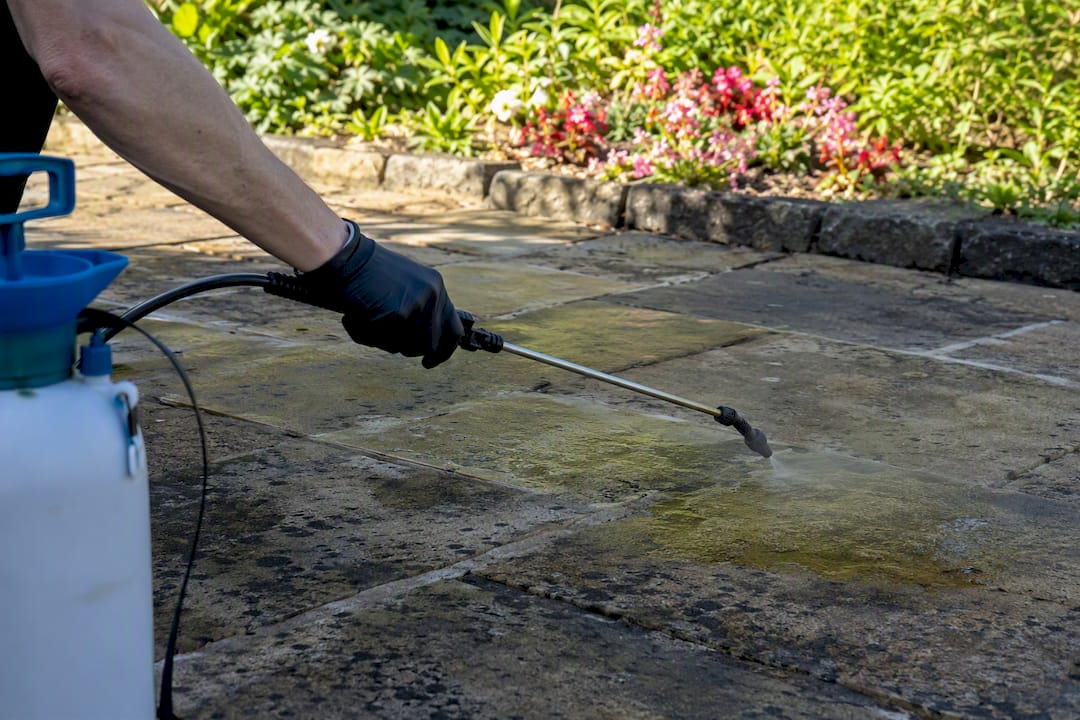
- Apply the product neat or diluted exactly as the label states. Manufacturer guidance for products such as No More Black Spot calls for a neat application.
- Keep the treated area visibly wet. Reapply if it starts drying out before the dwell time is up.
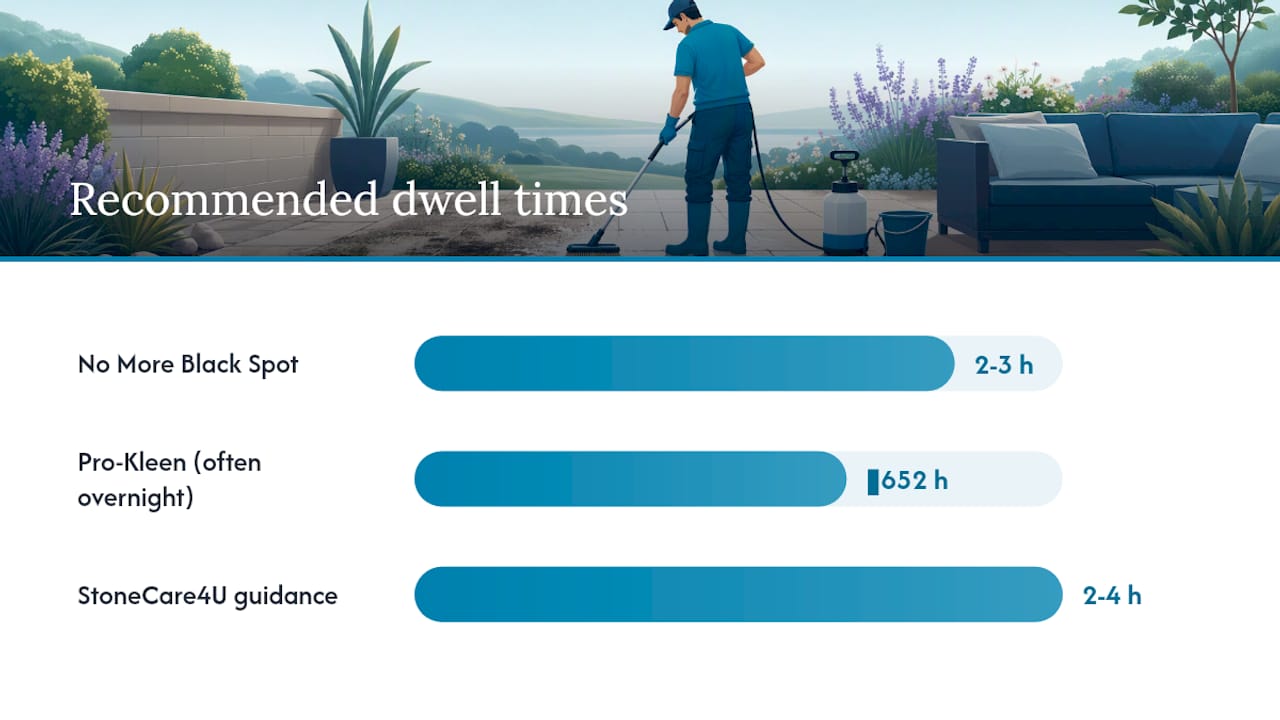
- Leave it to dwell. Manufacturer instructions for No More Black Spot recommend 2 to 3 hours, sometimes longer, until spots turn white, while Pro-Kleen’s sodium hypochlorite formula asks for a minimum of 2 hours and often overnight on tougher deposits.
- Agitate only if the label says to. Most modern formulas are designed to work without scrubbing.
- Rinse at low pressure once the black has visibly turned white or grey.
- Check back after a day or two and reapply to any patches that didn’t fully whiten.
Pro Tip: Don’t rinse too early. StoneCare4U’s guidance notes that black spot removers typically need 2 to 4 hours to work, and rinsing before the colour fully changes just washes away active product and wastes the whole application.
Never reach for household bleach here. It can bleach the mark cosmetically but rarely kills the lichen’s root structure, so it comes back, often within a season, and it can damage nearby plants in the process.
Which patio black spot removers actually work?
Three categories of product genuinely earn their keep: dedicated alkaline biocide blends made specifically for black spot, lichenicide treatments aimed at crustose growth, and a handful of general patio cleaners that have been independently tested against black spot specifically. Expert Reviews singles out Smartseal Patio Clean Xtreme as one of the stronger performers, though it notes some formulas need a little light scrubbing on the worst patches and can cost more than budget alternatives.
What to avoid is just as important: household bleach, strong acids, and anything applied under high pressure to soft stone. Household mixtures like vinegar or washing powder can lift surface grime but lack the surfactants and biocides to touch deeply rooted lichen, and they tend to regrow faster than a proper chemical treatment.
| Surface | Compatibility | Notes |
|---|---|---|
| Sandstone | Test patch essential | Soft and porous; avoid high pressure |
| Limestone | Test patch essential | Absorbs chemicals fast; use alkaline, stone-safe formulas |
| Slate | Generally tolerant | Can delaminate under excessive pressure |
| Granite | Good tolerance | Dense; low risk with most labelled cleaners |
| Concrete | Good tolerance | Watch for staining if product dries out mid-treatment |
Pro Tip: Most concentrates cover roughly 20 to 30 square metres per litre when diluted, but always check the specific product label. A pump sprayer gives more even coverage than a watering can, especially on textured stone.
When should you hire a professional instead of doing it yourself?
DIY makes sense for a small patio with light, recent growth. Hiring a professional makes far more sense once the area is large, the black spot has been established for years, the stone is delicate, or there’s a real risk of chemical run-off into a border, pond, or drain.
Professionals like Freshexteriors use a soft-wash approach that controls chemical dwell time precisely, contains run-off, and finishes with a low-pressure rinse rather than blasting the surface. That combination is what protects soft sandstone and limestone from the scarring that aggressive DIY jet washing can cause.
Before booking anyone, ask:
- What dwell time and chemical will you use on my specific stone type?
- How do you contain run-off near planting or drains?
- Do you offer a written guarantee on the finish?
Pro Tip: If a contractor’s first suggestion is high-pressure blasting on natural stone, treat it as a red flag. That’s the fastest way to strip a patio’s finish rather than restore it.
How do you stop black spot coming back?
Prevention is cheaper than repeat treatment, and it’s mostly about denying lichen the damp, shaded conditions it thrives in.
- Give the patio a gentle wash every 6 to 12 months and spot-treat any new growth the moment it appears, before it establishes.
- Improve drainage and sunlight where you can. Trim back overhanging branches and fix any spots where water regularly pools.
- Consider a breathable sealer once the surface is fully clean and dry, but always test a small area first. The wrong sealer traps moisture underneath and can actually accelerate discolouration rather than prevent it.
Pro Tip: A patio that dries out fully within a few hours of rain is far less hospitable to lichen than one that stays damp overnight. Improving airflow around the edges often does more good than any product.
How long does black spot removal take, and what does it cost?
Results usually show within 2 to 4 hours of a single treatment, with the full clean, including rinse, wrapped up the same day or by the next morning. Genuinely stubborn, long-established patches sometimes need a second application.
- DIY cost: a typical concentrate covering 20 to 30 m² per litre usually runs to a modest per-square-metre cost, plus your own time and equipment.
- Professional cost: priced per square metre or as a fixed job quote, varying with patio size, stone type, and access. Freshexteriors provides a written quote before any work starts.
How Freshexteriors approaches patio black spot removal
Every job starts with an inspection and a test patch, because the right chemical for sandstone isn’t always right for slate or concrete. From there:
- Targeted application of manufacturer-approved biocide treatments, matched to the specific stone.
- Controlled dwell time rather than guesswork, checked against how the colour is changing.
- Low-pressure rinse only once the treatment has done its job, followed by repointing or sealing if the patio needs it.
- Run-off containment and plant protection throughout, with before-and-after documentation so you can see exactly what’s changed.
The difference between a patio that looks clean for a fortnight and one that stays clean for years almost always comes down to dwell time and rinse pressure, not the strength of the chemical. Get those two things right and the rest follows.
Freshexteriors backs every job with a workmanship guarantee, and customer reviews consistently point to the same thing: visible, lasting results rather than a temporary cosmetic fix.
What does patio black spot removal actually cost, DIY vs professional?
For a small patio, that might mean one or two bottles. For a larger area, or one with stubborn, years-old growth, you could easily need three or four applications across the season, plus a pump sprayer, gloves, eye protection, and time. Add it up and DIY isn’t always the bargain it first looks, especially once you factor in a wasted afternoon if the dwell time or dilution goes wrong and you have to start again.
Professional pricing works differently. Freshexteriors quotes per square metre or as a fixed job price, and that figure already includes the biocide treatment, the soft-wash equipment, containment for run-off, and the low-pressure rinse. Larger jobs, harder stone types, and tricky access all affect the final number, but you’re not paying for trial and error. You also get a guarantee, which no DIY bottle comes with.
The honest comparison isn’t just product cost versus labour cost. It’s the risk of getting the chemistry wrong on soft natural stone, potentially causing damage that costs far more to put right than the original black spot ever did. For a small, lightly affected patio, DIY is a reasonable weekend project. For anything larger, older, or built from delicate stone, a written professional quote is worth getting before you spend money on products that might not fix the problem properly.
A note from the field
I’ve seen more patios damaged by impatience than by the wrong product. People rinse too early, or reach for a jet washer set to full pressure on sandstone that needed a gentle hand. The soft-wash-and-dwell method isn’t glamorous, but it’s what consistently works.
Book a professional patio clean with Freshexteriors
Freshexteriors is the alternative to trial-and-error DIY treatments for stubborn or large-scale patio black spot: one soft-wash visit, controlled dwell time, and a low-pressure rinse, without the risk of scarring soft stone or wasting a weekend on a product that doesn’t quite work.

The service covers patio and driveway cleaning, moss and algae treatment, and repointing or sealing where the stone needs it after treatment. To get a quote, have your patio’s approximate size in square metres, the stone type, and a few photos of the affected areas ready. Freshexteriors offers transparent, upfront pricing and a workmanship guarantee, backed by before-and-after photo evidence on completed jobs. If your black spot has been there for more than a season, or you’re not confident handling chemicals near planting and drains, request a quote from Freshexteriors and get a firm price before you commit to anything.
Sources
- Best patio cleaner 2026: Our tested picks for all budgets | Expert Reviews
- As recommended in the SUNDAY EXPRESS – Best Patio Black Spot Remover: NO MORE BLACK SPOT
- 5L Pro-Kleen Super Strength Black Spot Remover – Pro-Kleen
- Black Spot Remover – Powerful Outdoor Cleaner – StoneCare4U