
Efflorescence removal from brick is almost always achievable, but success depends far less on the cleaner you choose than on what happens to the moisture behind it. Most cases clear up with dry brushing and a plain water rinse. Persistent white crusts usually need a proprietary masonry cleaner, and only the toughest deposits justify diluted muriatic acid, which is a last resort, not a starting point.
- Light, fresh bloom: dry brush, then rinse. Job done in an afternoon.
- Moderate, sticky deposits: proprietary efflorescence remover, tested first on a hidden patch.
- Hard white crusts or repeat offenders: dilute acid or a professional assessment, because the moisture source almost certainly hasn’t been fixed.
If the staining keeps returning after repairs, or the brick is coloured or heavily textured, that’s your cue to call in a specialist rather than keep experimenting.
Key Takeaways
Efflorescence is removable in nearly every case, but it only stays gone once the moisture path behind it is fixed, not just the visible salts.
| Point | Details |
|---|---|
| Start mild, escalate slowly | Dry brush and water rinse first; save proprietary cleaners and acid for deposits that won’t shift otherwise. |
| Always test patch | Try any cleaner or acid dilution on a hidden area first to catch colour or texture changes before they’re visible. |
| New builds need time | Allow up to a year for fresh construction bloom to weather away naturally before treating it. |
| Fix the water, not just the stain | Repointing, flashing repair, and clear weep holes stop efflorescence returning after cleaning. |
| Call a specialist for recurring cases | Freshexteriors offers site surveys, test patches, and low-pressure brickwork cleaning with transparent per-square-metre pricing. |
Table of Contents
- What efflorescence removal from brick actually involves
- Should you wait it out or treat it now?
- Tools, PPE and cleaners you’ll need for the job
- Step-by-step: removing efflorescence from least to most aggressive
- Using acids and commercial cleaners safely
- Stopping efflorescence from coming back
- When hiring a professional makes more sense
- When it’s time to bring in Freshexteriors
- Frequently asked questions
- Sources
What efflorescence removal from brick actually involves
Efflorescence is the white, powdery or crystalline residue you see on brick, block and render. It’s water-soluble salts, mostly sulphates and carbonates, that have travelled to the surface dissolved in moisture and been left behind once that water evaporated.
The mechanism is straightforward: water enters the masonry, picks up soluble salts from mortar, backing units, or even the ground, and carries them to the surface as it migrates outward. When it evaporates, the salts crystallise and stay put. ASTM C67 includes a specific efflorescence test for clay brick, but it only flags salts originating in the brick itself. It won’t catch salts introduced through mortar, cement backing, or ground contamination, which is why two identical-looking brick walls can behave completely differently.
Sources of these salts include:
- Portland cement mortar (a common contributor)
- Clay or concrete backing units
- Groundwater and rising damp carrying dissolved minerals
- De-icing salts and fertilisers splashed up from nearby paving or borders
Pro Tip: Don’t rush out to wash efflorescence off during cool, damp weather. Adding more moisture to already-saturated masonry can push fresh salts to the surface faster than you’re removing the old ones, so pick a warm, dry stretch of days instead.
Should you wait it out or treat it now?
New brickwork often develops a haze of salts in its first year as residual construction moisture works its way out. This is “new building bloom,” and it typically weathers away on its own within about twelve months under normal rain and sun exposure.
Run through this before reaching for a brush:
- How old is the brickwork? Under a year, and the deposit is light? Give it more time.
- Is it loosely dusted or hard and adherent? Loose powder brushes off easily; hard crusts signal ongoing water movement.
- Where is it located? Isolated patches near ground level often point to splashback or drainage issues rather than a wall-wide problem.
- Has there been recent building work, repointing, or a leak? That changes the diagnosis entirely.
If the same patch keeps reappearing weeks after cleaning, or you notice damp patches, cracked render, or staining that tracks a specific line (under a windowsill, along a parapet), treat that as moisture ingress requiring repair before any cleaning happens.
Tools, PPE and cleaners you’ll need for the job
Keep the toolkit simple. A stiff nylon or natural-fibre brush handles most jobs; reserve a soft acid brush strictly for chemical work. A garden hose or low-pressure washer covers rinsing.
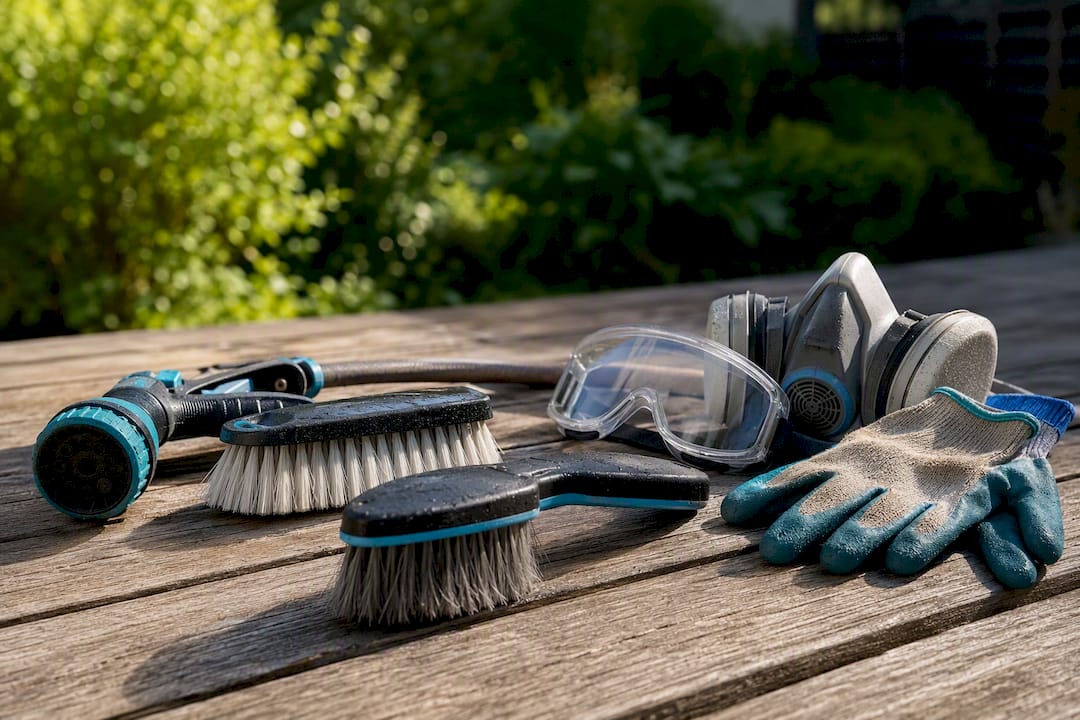
For protective gear: gloves, eye protection, a respirator rated for the chemical you’re using, and clothing that covers skin and won’t be ruined by splashes.
On cleaners, work up the ladder: proprietary masonry cleaners like Prosoco Sure Klean or EF‑FORTLESS handle most stubborn deposits, and diluted muriatic (hydrochloric) acid stays a genuine last resort.
Never use a wire brush. Steel fragments embed in the brick and rust, leaving orange staining that’s harder to fix than the efflorescence ever was. Always test any product on a hidden patch first, since manufacturers’ own guidance treats this as a non-negotiable step, not an optional precaution.
Step-by-step: removing efflorescence from least to most aggressive
Work through these in order, and stop as soon as a step clears the problem. Before any of them, pick a small, hidden patch and record how the brick responses.
- Dry brush first. A stiff fibre brush lifts loose, powdery salts without introducing any water. If the deposit disappears here, you’re finished.
- Brush with water. Wet the brush and scrub in circular motions, rinsing as you go. This handles most moderate bloom that dry brushing alone can’t shift.
- Low-pressure washing. A garden hose or washer set well below driveway-cleaning pressure rinses residue from mortar joints and textured faces. Avoid high pressure here; it erodes the brick’s fired surface, called spalling, and that damage is permanent.
- Poultice for stubborn, localised patches. Mix an absorbent material (whiting or fuller’s earth) with water into a paste, apply thickly over the stain, cover, and let it draw salts out as it dries over 24 to 48 hours before brushing away.
- Proprietary masonry cleaners. Follow the manufacturer’s dilution and dwell time exactly, agitate with the brush, then rinse thoroughly. Recommended sequencing places these ahead of any acid treatment for good reason: they’re formulated for brick and far more forgiving than a site-mixed solution.
- Dilute muriatic acid, last resort only. Pre-wet the wall so the brick doesn’t absorb acid directly, work in small sections, keep dwell time short, and rinse immediately and thoroughly.
Pro Tip: Photograph your test patch before and 24 hours after treatment. Colour shifts and texture changes sometimes only show up once the surface has fully dried, and you want to catch that on a hidden corner, not the front elevation.
Stop and call a professional if the staining returns within weeks of cleaning, if you’re dealing with hard calcium carbonate crusts, if the brick is integrally coloured, or if you notice mortar softening during the process. That’s your masonry telling you the moisture problem hasn’t been solved.
Using acids and commercial cleaners safely
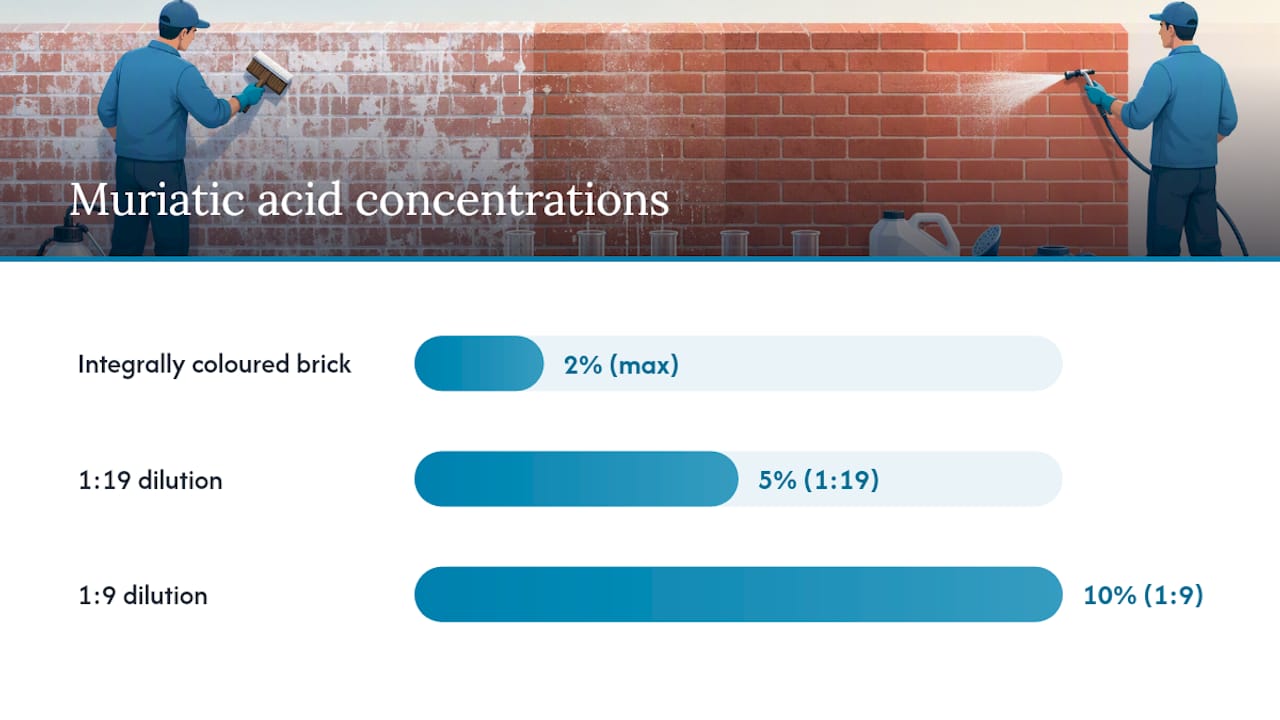
Muriatic acid dilution depends heavily on the brick. Integrally coloured brick tolerates roughly 2% acid solutions at most; standard red clay brick can sometimes take stronger mixes, but industry guidance generally keeps ratios between 1:9 and 1:19, acid to water, and treats anything stronger as a last-ditch measure only after weaker dilutions fail. Always add acid to water, never the reverse, to avoid a dangerous exothermic splash-back.
Where possible, reach for proprietary alternatives first. Cleaning brickwork guidance notes that products developed alongside brick manufacturers behave far more predictably across different clay bodies than a homemade acid mix.
Application steps that matter:
- Pre-wet the surface thoroughly so the brick doesn’t drink the acid straight in
- Work in patches no larger than roughly 0.37 square metres (4 square feet) at a time
- Keep dwell time to around five minutes, agitating with the brush, then rinse immediately and thoroughly
- Never let treated areas dry before rinsing; that’s when etching and permanent discolouration set in
Stopping efflorescence from coming back
Cleaning without fixing the water source buys you weeks, not years. Technical guidance on efflorescence causes is blunt about this: treat the moisture, or expect a repeat performance.
Work through this checklist before you consider the job finished:
- Repair or install flashing above openings and at roof-to-wall junctions
- Check weep holes aren’t blocked with mortar droppings or debris
- Clear gutters and downpipes, and confirm they discharge away from the wall base
- Correct ground levels so soil doesn’t sit above the damp-proof course
- Repoint open or crumbling mortar joints
- Consider a breathable siloxane water repellent once the wall is dry and clean, ideally after repairs
Don’t reach for a non-breathable sealer as your primary fix. It traps moisture behind the surface, which often makes salt migration and spalling worse over time, not better.
When hiring a professional makes more sense
Some jobs are worth handing over. Call in a specialist when efflorescence keeps returning despite repairs, when you’re facing hard calcium carbonate crusts, when the affected area is extensive, or when the brick is coloured or textured in a way that makes uneven treatment obvious.
A competent professional will diagnose the moisture source before touching a cleaner, run test patches on unobtrusive areas, and choose between soft washing, low-pressure rinsing, or chemical treatment based on what the brick and the salt chemistry actually need.
Before booking anyone, ask for:
- A written site survey and scope of work
- A documented test-patch result before full application
- Warranty or guarantee terms in writing
- Before-and-after photographs from comparable jobs
A specialist’s notes on efflorescence jobs
Most callouts share the same mistake: someone tackled the staining with a pressure washer on full power, or an acid mix with no test patch, and now there’s etching to deal with on top of the original salts. Patience beats force here almost every time.
A typical job runs survey, test patch, cleaning, then moisture repairs, followed by a check-in weeks later to confirm the salts haven’t returned. Keep your own before-and-after photos regardless of who does the work; they’re the clearest proof the job actually held.
When it’s time to bring in Freshexteriors
If you’ve read through the poultice steps, the acid dilution ratios, and the weep-hole checklist and thought “I’d rather someone else handled this,” that’s exactly the gap Freshexteriors fills. Rather than juggling test patches and dwell times on a ladder yourself, you get a specialist who’s diagnosed hundreds of moisture problems before ever picking a cleaner.

Freshexteriors handles brickwork and stone cleaning, patio and driveway repointing, render cleaning, and gutter, fascia and soffit work, meaning the same visit that clears your efflorescence can also sort the blocked gutter or failed flashing causing it. Every job starts with a site survey and a test patch before full application, priced transparently per square metre so there’s no guessing what the final bill looks like. You get specialist low-pressure equipment calibrated to avoid the surface damage a hired pressure washer can cause, plus guarantee terms and before-and-after photographs as standard.
If your brickwork keeps staining despite your best DIY efforts, request a survey or test patch estimate from Freshexteriors and get a straight answer on what’s actually causing it.
Frequently asked questions
Does efflorescence damage brick permanently?
No, the salt deposits themselves sit on the surface and don’t damage the brick. The moisture movement behind them can eventually cause spalling or mortar breakdown if left uncorrected for years.
How long does efflorescence removal from brick usually take?
A light bloom clears in an afternoon with brushing and rinsing. Moderate cases with proprietary cleaners take a day including dwell and rinse time, while jobs needing moisture repairs first can stretch across several weeks once repointing or flashing work is factored in.
Can I use vinegar or household cleaners instead of proprietary products?
Household acids are far less predictable than formulated masonry cleaners and can etch or discolour brick unpredictably. Stick to products designed for masonry and test them first.
Will a water repellent stop efflorescence for good?
Only if applied after the underlying moisture source is fixed. A breathable siloxane repellent helps reduce recurrence, but sealing damp brick without repairs traps moisture and can make salt problems worse.
Sources
For deeper technical detail on salt chemistry, dilution protocols, and cleaner selection, consult the Brick Industry Association’s Technical Note 23A, the PCA/IS239 note referencing ASTM C67, and NCMA’s EFFLO‑TEK 08‑03A guidance.
- Efflorescence – Causes and Prevention (Technical Note 23A)
- Cleaning brickwork (Technical note)
- Removal and prevention of efflorescence on concrete and masonry building surfaces (USACE/ERDC technical note)