
Soft wash your roof, siding, fencing and painted wood. Pressure wash your concrete driveway, brick patio and other hard, durable surfaces. The difference comes down to mechanism: pressure washing blasts away dirt with mechanical force, while soft washing uses biocidal chemistry to kill algae and moss at the root. Get this backwards and you risk stripping shingles or cracking render.
TL;DR:
- Soft washing kills algae and moss at the root with biocidal solutions, resulting in longer-lasting cleanliness compared to pressure washing’s immediate dirt removal.
- Pressure washing is effective on hard surfaces like concrete and brick but risks damaging softer or delicate materials such as shingles or aged render.
- Proper chemical dilution and containment are crucial for soft washing to prevent plant damage and avoid regulatory issues with water runoff.
- Combining both methods often yields the best results, with soft washing for organic growth and pressure washing for embedded dirt on hard surfaces.
- Professional advice should specify surface-specific PSI and chemical use, prioritize safety, and include a detailed containment and pricing plan.
Table of Contents
- Pressure washing vs soft washing: what pressure washing actually does
- Soft washing vs pressure washing: the chemistry behind the low-pressure method
- Pressure washing vs soft washing compared side by side
- How do you choose the right method for each part of your property?
- Protecting plants, pets and drains during exterior cleaning
- Fresh Exteriors: evidence from our work and practical examples
- What homeowners get wrong most often
- Getting a professional quote for your property
- Sources
Pressure washing vs soft washing: what pressure washing actually does
Pressure washing removes dirt, grease and biological growth by mechanical force alone. Water is forced through a nozzle at high velocity, physically stripping contamination off a surface rather than dissolving it chemically. According to Wikipedia’s overview of the method, commercial and heavy-duty applications commonly run from around 1,500 up to 4,000+ PSI, while lighter domestic tasks sit well below that.
PSI (pounds per square inch) tells you how hard the water hits. GPM (gallons per minute) tells you how much water is moving, and it matters just as much. A high PSI with low GPM struggles to clear a wide driveway efficiently, whereas a machine with strong GPM covers ground faster and rinses detergent residue more thoroughly.
Cold water handles most exterior grime: dirt, moss, general staining on concrete and brick. Hot water earns its place on jobs involving grease, food waste or heavy oil, such as commercial kitchen exteriors, bin areas and some driveways with old vehicle stains, because heat breaks down oils that cold water simply pushes around.
Two accessories change outcomes more than most homeowners expect:
- Surface cleaners — rotating flat attachments that give even, streak-free coverage on patios and driveways, avoiding the tramline marks a wand leaves behind.
- Nozzle angle — a 15 or 25 degree tip clears grime fast; a 0 degree pinpoint jet can gouge softwood, crack render, or force water behind cladding.
Pressure washing suits concrete, natural stone, sealed brick and most hard, durable surfaces. It’s the wrong tool for asphalt shingles, soft or ageing render, painted timber, and fibre cement siding, where the force strips protective coatings and drives moisture into joints it should never reach.
Soft washing vs pressure washing: the chemistry behind the low-pressure method
Soft washing works below 500 PSI at the surface, according to guidance from Power Line Industries, which is roughly the pressure of a garden hose fitted with a decent nozzle. The cleaning power doesn’t come from force. It comes from a biocidal solution, commonly built around sodium hypochlorite paired with a surfactant that helps the mixture cling to vertical and textured surfaces instead of running straight off.
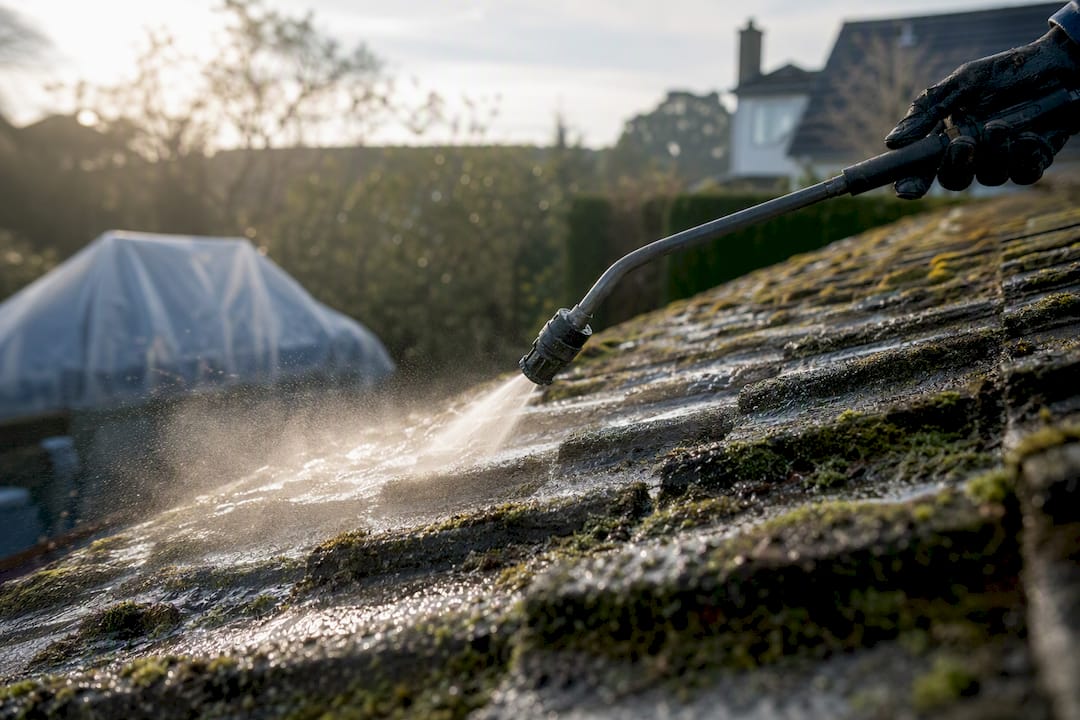
Dwell time is what makes soft washing effective long after the visible cleaning is done. The solution sits on the surface long enough to penetrate algae, moss and lichen down to the spore and root structure, not just the visible growth on top. That’s why properly soft-washed roofs and siding typically stay clean far longer than a surface that’s simply been blasted, since a pressure wash removes what you can see while leaving spores behind to regrow within months.
Soft washing has clear limits. It does nothing for embedded oil stains, rust marks, or heavy mineral deposits from hard water. Those are physical or chemical bonding problems, not biological ones, and no amount of dwell time will lift them. This is exactly why soft washing doesn’t replace pressure washing outright. Each method solves a different kind of dirt.
Handling these chemicals safely takes real care:
- Pre-wet and cover plants, shrubs and lawn edges before application.
- Dilute according to surface type. Roofs, siding and delicate render all take different concentrations.
- Never apply on windy days, when overspray can drift onto neighbouring property or vegetation.
- Rinse thoroughly at low pressure once dwell time is complete.
Pro Tip: If you can smell strong chlorine from more than a few metres away during a soft wash, the dilution is probably too aggressive. A well-mixed solution shouldn’t overpower the air around a property.
Getting the ratio wrong isn’t a minor slip. Over-diluted solution fails to kill spores and the growth returns within weeks. Over-concentrated solution can scorch grass, discolour paintwork or bleach vinyl trim, which is exactly why operator skill and dilution experience matter as much as the chemical itself.
Pressure washing vs soft washing compared side by side
Put the two methods next to each other and the decision usually makes itself, because they’re built for genuinely different jobs rather than being two strengths of the same tool.
| Factor | Pressure washing | Soft washing |
|---|---|---|
| Pressure range | Roughly 1,500–4,000+ PSI for heavy-duty work | Under 500 PSI at the surface |
| Cleaning mechanism | Mechanical force | Biocidal chemistry (commonly sodium hypochlorite plus surfactant) |
| Best surfaces | Concrete, sealed brick, natural stone, industrial flooring | Roofs, render, painted wood, fibre cement siding, delicate finishes |
| Surfaces to avoid | Shingles, soft render, painted timber, ageing siding | Heavy oil stains, rust, mineral scale |
| Result longevity | Visible dirt removed immediately; growth often returns within months | Kills spores at the root; results typically last considerably longer |
| Safety/damage risk | Can strip granules, crack render, force water behind cladding | Chemical drift can harm plants; needs correct dilution |
| Cost drivers | Time, water usage, surface area, hot water equipment | Chemical cost, dwell time, dilution expertise |
Using high pressure directly on asphalt shingles strips the protective granules, shortens the roof’s usable life and can void a roofing manufacturer’s warranty outright. That single fact explains why most reputable operators refuse to pressure wash a roof under any circumstances.
In practice, professional jobs often blend both methods rather than picking one exclusively. A technician might soft wash a driveway to kill algae in the joints, then follow with a targeted low-pressure rinse to lift the loosened residue and any remaining grit the chemistry couldn’t shift on its own. Heavily soiled hardscapes, meanwhile, genuinely need the mechanical force and sufficient GPM that only pressure washing provides, particularly where oil and ground-in dirt sit on concrete or brick.
Method choice also has consequences beyond the visible clean. Using the wrong approach on a roof or siding can void a manufacturer’s warranty, and repeated pressure damage to render or brick joints shortens the lifespan of the surface itself, turning a routine clean into an expensive repair years down the line.
How do you choose the right method for each part of your property?
Match the method to the material, not to whichever machine happens to be sitting in the van. Here’s a practical run-through by surface:
- Roofs — soft wash only. High pressure strips granules and voids warranties; chemistry kills the moss and lichen without touching the shingle surface.
- Vinyl and fibre cement siding — soft wash. These materials can crack or have water forced behind panels under pressure, leading to hidden rot.
- Painted wood — soft wash, or very low-pressure rinse at most. Pressure strips paint and raises the grain.
- Decking (untreated timber) — low-pressure wash or soft wash depending on condition; aggressive pressure gouges soft grain and shortens the deck’s life.
- Fences — soft wash for painted or stained timber; light pressure acceptable on bare, weathered wood.
- Brick and natural stone — pressure washing is generally fine, though older, softer brick or lime mortar may need reduced pressure to protect the pointing.
- Concrete driveways and patios — pressure washing is the right call for embedded dirt, oil and tyre marks, sometimes preceded by a soft wash for organic staining in the joints.
Before booking anyone, ask four questions that separate a professional from someone with a rented machine:
- What PSI and GPM will you use on this specific surface?
- Which chemicals are you applying, and at what dilution?
- What’s your containment and run-off plan for plants and drains?
- Are you insured, and does your work carry any guarantee?
Pro Tip: A contractor who can’t tell you the PSI they’ll use on your roof, or who won’t name the chemical going into their tank, is not someone you want anywhere near your property.
Watch for red flags: no containment plan for run-off, reluctance to name chemicals, or an operator who insists high pressure is “fine” on render or shingles. That last one, in particular, is the single clearest sign to walk away.
Protecting plants, pets and drains during exterior cleaning
Soft washing chemicals are effective precisely because they’re strong enough to kill algae and moss at the root, which means they need respect around anything living nearby. Pre-wetting garden beds, shrubs and lawn edges before application dilutes any overspray that lands off-target, and covering delicate plants with sheeting adds another layer of protection during the job itself.
Run-off containment matters more than most homeowners realise. Chemical residue and dislodged grime shouldn’t be allowed to wash freely into storm drains or watercourses, and many professional jobs use neutralising rinses afterwards to bring treated surfaces back to a safe pH before final rinse-off. Regulations on this vary by area, so check local guidance if you’re planning to do the work yourself.
Operator safety matters as much as plant safety. Correct PPE, accurate dilution ratios and experience reading how a chemical behaves on a given surface are what separate a clean job from a damaged one. Some situations genuinely call for a professional rather than a DIY attempt:
- Large roof areas where fall risk and warranty terms are both in play.
- Commercial properties with run-off regulations attached to their lease or insurance.
- Any job near a pond, well, or protected watercourse.
Fresh Exteriors: evidence from our work and practical examples
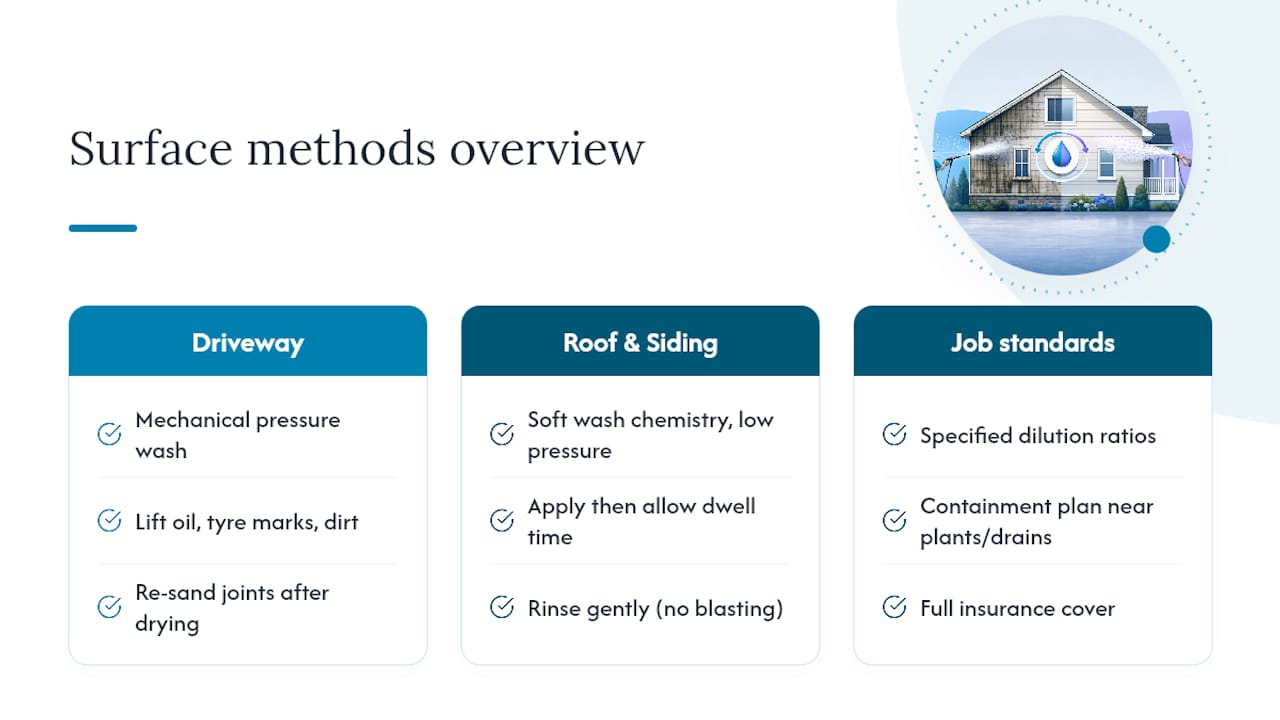
A typical driveway and patio job at Freshexteriors starts with a mechanical pressure wash to lift oil, tyre marks and ground-in dirt from the concrete or block paving, often followed by re-sanding the joints once the surface has dried. Roof and siding jobs run the other way entirely: soft wash chemistry applied at low pressure, given proper dwell time, then rinsed gently rather than blasted.
Combined jobs, such as a full exterior refresh covering render, driveway and gutters in one visit, are scheduled so each surface gets the method it actually needs rather than one blanket approach across the whole property. Every job runs on specified dilution ratios, a containment plan for run-off near plants and drains, and full insurance cover, because getting the method wrong on someone else’s property isn’t a risk worth taking.
What homeowners get wrong most often
Most people assume pressure washing is the “proper” clean and soft washing is the lesser option because it doesn’t blast anything visibly. That’s backwards. The one-line rule worth remembering is this: match the method to the surface, and when you’re not certain which one that is, default to soft washing or call a professional, because a mistimed low-pressure job is recoverable and a mistimed high-pressure job on a roof usually isn’t.
The practical money-saving move is bundling. Booking a driveway pressure wash alongside a roof or siding soft wash in the same visit saves on repeat call-out costs and means both jobs get scheduled around the same drying window, rather than paying for two separate visits months apart.
— Michael
Getting a professional quote for your property
There’s a reason so many homeowners end up calling in a professional after weighing pressure washing against soft washing themselves: getting the method wrong on a roof or render costs far more to fix than the original clean would have cost to do properly. Freshexteriors handles both sides of the job under one roof, from driveway and patio cleaning through to roof, render and siding soft washing, moss and algae treatment, and gutter, fascia and soffit cleaning.

A proper quote should walk your property surface by surface, specify the PSI or chemical dilution planned for each area, set out a containment plan for run-off near plants and drains, and price the job on a clear per-square-metre basis rather than a vague estimate. That’s the standard Freshexteriors works to on every booking. If your driveway needs pressure and your roof needs chemistry, get a quote from Freshexteriors and have both handled properly in the same visit.