
Most diesel stains can be removed, but the outcome depends on how long the fuel has sat and how porous the surface is. Fresh spills lifted within hours often clean up in a single visit; stains left for weeks soak deep into concrete and need repeat treatment. The professional standard is an alkaline degreaser followed by hot-water pressure cleaning, with extraction or poultice cycles for anything embedded. This combination is used on driveways, forecourts, and car parks, often with wastewater containment included.
TL;DR:
- Professional cleaning is essential for stains more than a few weeks old or that have changed color, as deep-set contamination cannot be fully removed with DIY methods.
- Proper treatment involves chemical breakdown with alkaline degreasers, hot-water pressure washing, and extraction or poultice cycles to draw residual hydrocarbons out of surfaces.
- Surface type determines cleaning parameters, with concrete tolerating high pressure and strong cleaners, while asphalt, block paving, and sealed surfaces require gentler methods to prevent damage.
- Wastewater containment is crucial to prevent environmental contamination, with professionals using systems to recover and properly dispose of contaminated wash water.
- Multiple treatment cycles are often necessary for older stains, and weather conditions like cold or rain can prolong or weaken cleaning efforts, requiring scheduling adjustments.
Table of Contents
- When should you call a professional instead of DIY?
- What professional diesel cleaning actually involves
- What happens during a professional diesel-cleaning job
- Does the surface change how diesel stains should be treated?
- How can you stop diesel stains coming back?
- Why wastewater capture matters more than most people think
- What does a professional diesel cleanup cost, and how long does it take?
- Does weather affect how well diesel stains clean up?
- What happens to diesel that isn’t cleaned up properly?
- A technician’s honest view on what to expect
- Book a professional diesel and oil stain clean with Freshexteriors
- Sources
When should you call a professional instead of DIY?
A spill you spot within the hour, on a hard, non porous surface, is usually a DIY job. Absorb it with a granular material like cat litter, then treat the residue yourself. Once diesel has had days to soak into concrete, the odds of a garden pressure washer shifting it drop sharply, because the fuel has already migrated below the surface where a domestic machine’s pressure and flow rate can’t reach it.
Scale changes the calculation too. A single patch on a driveway is manageable; a forecourt with dozens of overlapping stains, tyre marks, and years of ground-in oil is a different job entirely, and one that carries genuine liability if customers or staff slip on it.
Call a professional when:
- The stain is more than a few weeks old or has changed colour (a sign it’s set into the pores)
- You’re dealing with a commercial car park, forecourt, or any area open to the public
- Runoff from cleaning could reach a drain, watercourse, or shared surface water system
- Previous DIY attempts have lightened but not removed the mark
What professional diesel cleaning actually involves
A proper job starts with inspection, not a hose. Technicians map the affected area, note the surface type, and judge how deep the contamination runs before choosing a treatment plan. That decision shapes everything that follows.
The chemistry does the heavy lifting first. Alkaline degreasers, typically around pH 12 to 13, break down the hydrocarbon bonds that hold diesel to concrete or block paving, and professionals recommend giving these products proper dwell time with some mechanical agitation before rinsing. Rushing this stage is the single biggest reason DIY attempts fail.
Then comes hot-water pressure washing, run at controlled PSI with surface-cleaner attachments rather than a narrow wand. Heat lowers the fuel’s viscosity, which makes it far easier to flush out of the pores than cold water ever manages.
For stains that have properly bedded in, surface cleaning alone won’t finish the job. Extraction or poultice treatments draw the hydrocarbons back out of the material, often across more than one cycle, because a wet surface can hide residual contamination that only reveals itself once it dries.
Throughout, contaminated wash water gets captured rather than left to run into a drain.
Pro Tip: If a quote doesn’t mention what happens to the wash water, ask. Reputable contractors will have a clear answer, because it’s a genuine regulatory concern, not an afterthought.
What happens during a professional diesel-cleaning job
A typical job follows a set sequence, and knowing the stages helps you judge whether a contractor is doing it properly.
- Site preparation. Drains get protected, containment barriers go down where needed, and the affected area is cleared of debris and loose surface material.
- Degreaser application. An alkaline cleaner goes on the stain, with light scrubbing or brushing to work it into the surface, then left to dwell.
- Hot-water pressure washing. Passes with a surface cleaner or spin-jet tool lift the loosened contamination, working methodically across the treated area rather than randomly.
- Extraction or poultice follow-up. For stains that don’t lift fully, a poultice draws remaining hydrocarbons out, and the surface is left to dry fully before assessment, because shadows that reappear on drying signal embedded contamination rather than a finished job.
- Final rinse and inspection. Once the technician is satisfied, a neutralising rinse follows, and sealing can be discussed as an optional next step.
Many providers work the area in sections rather than treating it as one uniform patch. Dividing a job into working grids lets technicians target problem zones individually, which conserves chemical use and shows exactly how deep a stain runs as each section dries.
Older stains rarely come out in one pass. Industry guidance consistently points to multiple treatment cycles for diesel that has had weeks to set, which is worth factoring into both your timeline and your budget before the job starts.
Does the surface change how diesel stains should be treated?
Yes, and getting this wrong is how surfaces get damaged rather than cleaned. Concrete, asphalt, and block paving each respond differently to pressure and chemistry.
- Concrete tolerates higher pressure and stronger alkaline cleaners well, which is why extraction methods work best here on aged stains.
- Asphalt needs a gentler hand. High pressure and harsh degreasers can dislodge the aggregate binding the surface, so professionals typically drop the PSI and use milder chemistry.
- Block paving and sealed decorative finishes are the most vulnerable. Aggressive pressure can strip jointing sand or damage a sealant layer, so chemical treatment at low pressure is usually the safer route.
- When cleaning stops being worth it. On badly pitted or heavily stained older surfaces, a sealer or a partial block replacement can sometimes deliver a better result for less money than repeated aggressive cleaning cycles.
Recommended pressure and heat ranges vary by surface too. Guidance for hot-water systems typically runs 2,000 to 3,500 PSI with water heated to 80 to 90°C, adjusted down for softer or more decorative materials. Any contractor quoting one blanket pressure setting for every surface type is worth questioning.
How can you stop diesel stains coming back?
Prevention is far cheaper than repeat cleaning, and most of it is basic housekeeping.
- Seal after cleaning, not before. A penetrating masonry sealer applied to porous concrete reduces future staining risk substantially, but it only works once existing contamination has been removed. Sealing over an active stain traps it in place.
- Reapply on a schedule. Most sealers need reapplying every two to three years depending on footfall and weather exposure.
- Match cleaning frequency to use. A residential driveway might need attention once a year; a retail car park or forecourt with constant vehicle turnover benefits from a routine schedule, not a reactive one.
- Control the source. Drip trays under parked vehicles, designated bays for anything that leaks, and absorbent granules kept on site for fresh spills all reduce how often you need a full clean.
Pro Tip: Keep a bag of granular absorbent near any area where vehicles regularly park. Acting within the first hour of a spill dramatically improves the chance of full removal without any specialist treatment at all.
Why wastewater capture matters more than most people think
Letting hydrocarbon-laden wash water run into a drain isn’t just messy; it’s a genuine environmental risk, since diesel residue carried into surface water systems can contaminate watercourses well beyond the site itself. This is one of the main reasons DIY pressure washing struggles on anything beyond a small patch.
Professional contractors typically manage this with:
- Vacuum recovery systems that lift wash water straight off the surface as they work
- Pump-and-tank setups for larger areas, holding contaminated water for proper disposal
- Silt and hydrocarbon separation before any water is released
On commercial or public-facing sites, this isn’t optional. Regulators can issue fines or force a site closure over contaminated runoff, and capturing wash water is standard practice on forecourt jobs for exactly that reason. Containment measures are applied on jobs where runoff risk warrants it, rather than treated as an afterthought.
What does a professional diesel cleanup cost, and how long does it take?
Price depends on several moving parts, not a flat rate per square metre.
- Area size is the obvious driver, but stain age matters just as much: a fresh mark costs less to shift than one that’s had months to set.
- Surface type affects both chemistry and pressure choices, which affects labour time.
- Heat requirement and wastewater handling add cost on larger or commercial jobs where containment equipment is needed.
Timelines vary accordingly. A single spot treatment might take one to two hours. A small residential driveway is often a half-day job. A full forecourt can run a day or longer, particularly if older stains need a second visit once the surface has dried and revealed what’s left behind.
When comparing quotes, ask about dwell time on the degreaser, whether wastewater containment is included, and whether there’s any guarantee on the result for stains that have already had one unsuccessful cleaning attempt.
Does weather affect how well diesel stains clean up?
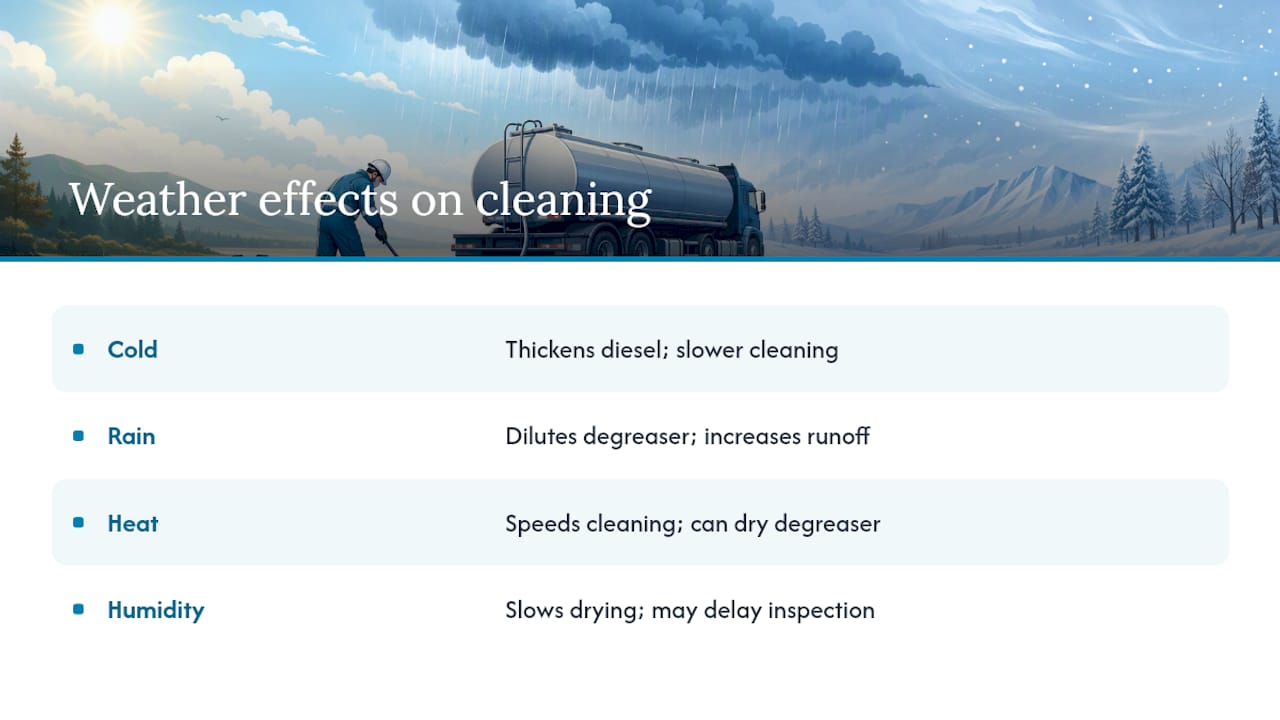
Temperature and rainfall both change the outcome of a cleaning job, sometimes significantly. Cold weather thickens diesel, making it harder for degreasers to penetrate and for hot water to keep working once it hits a chilled surface. Jobs scheduled in freezing conditions often need longer dwell times and more passes to match results achieved in milder weather.
Rain is the bigger practical problem. Cleaning during or immediately before wet weather risks diluting the degreaser before it’s had time to work, and it makes wastewater containment far harder to manage, since rainwater mixes with the treated runoff and increases the volume that needs capturing. Most professional contractors will reschedule around forecast rain rather than push ahead and get a weaker result.
Heat, by contrast, generally helps. Warm surface temperatures keep hot-water treatments effective for longer and speed up the drying phase that reveals whether a stain has actually lifted or is just hiding beneath a wet sheen. Direct sun on a freshly poured degreaser can cause it to dry out and lose effectiveness before it’s rinsed, though, so timing still matters even in good weather.
Humidity plays a smaller but real role too. Very humid conditions slow down the drying checks that tell technicians whether a poultice cycle worked, which can extend a job by hours or push a final inspection to the following day. None of this makes diesel cleanup impossible in poor weather, but it does change the schedule, the number of passes needed, and sometimes the final result on a first attempt.
What happens to diesel that isn’t cleaned up properly?
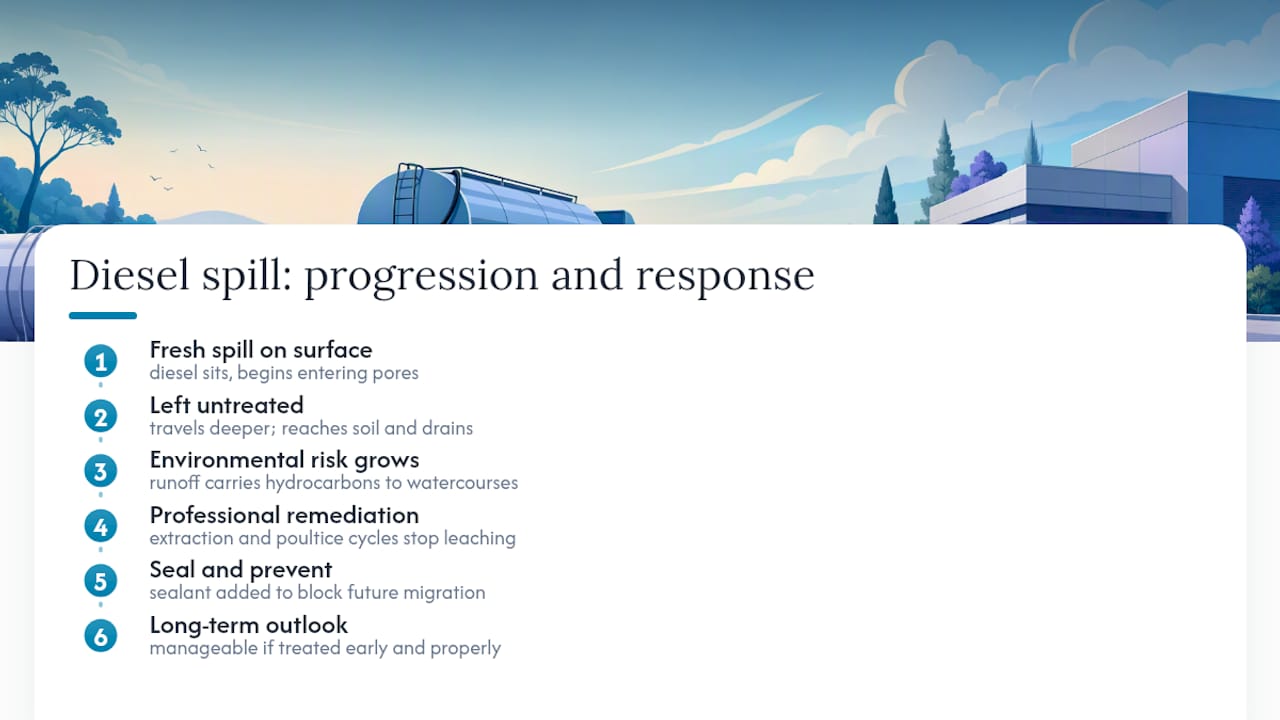
Diesel left untreated doesn’t just sit on the surface. It migrates into the pores of concrete and asphalt over time, and on unsealed ground it can work its way further down, affecting soil quality beneath the paving. The longer it’s left, the deeper it travels, which is precisely why professionals treat stain age as the biggest factor in how many cleaning cycles a job will need.
The environmental cost isn’t limited to the immediate stain either. Hydrocarbon residue carried by rainwater runoff can reach drains, watercourses, and shared drainage systems, which is part of why commercial sites face real regulatory scrutiny over contaminated surfaces. A stain that looks purely cosmetic on a driveway can represent a genuine environmental liability on a larger commercial site with public drainage nearby.
Proper remediation breaks this cycle at the surface level. Removing the hydrocarbon load through extraction and poultice cycles, rather than just lightening its appearance with a quick pressure wash, stops the contamination from continuing to leach further into the material. Sealing afterwards adds a barrier that keeps any future spill from repeating the same slow migration.
The long-term outlook is genuinely good news for property owners: unlike some forms of environmental contamination, surface-level diesel staining on paved areas is very manageable with the right process, and it doesn’t require the kind of large-scale remediation associated with major spills. The key is treating it early and treating it properly, rather than assuming a stain that’s stopped smelling has stopped being a problem.
A technician’s honest view on what to expect
Mixed-age stains rarely come out looking brand new. Targeted extraction lifts the contamination, but colour match against surrounding concrete isn’t always perfect, and setting that expectation upfront avoids disappointed customers. Sometimes a partial reseal is the more sensible call than another aggressive cleaning cycle on an already worn surface.
…
— Michael
Book a professional diesel and oil stain clean with Freshexteriors
A properly finished job when a stain has gone past the absorbent-and-scrub stage involves hot-water pressure washing, alkaline degreasers, and extraction cycles for embedded diesel, all with wastewater containment handled on site rather than left to chance.

A typical quote covers a site inspection to judge stain depth and surface type, containment planning where the job needs it, the cleaning cycles themselves, and a follow-up check once the surface has dried to confirm the stain is actually gone rather than just hidden under a wet sheen. The same visit can also cover driveway and patio cleaning, render and brickwork cleaning, or gutter, fascia, and soffit work if other areas need attention while the team is on site.
If diesel or oil has marked your driveway, forecourt, or car park, get a quote through the Freshexteriors booking page and find out what a proper clean will take before committing to anything yourself.